Wednesday, March 1, 2023

index


After the British slave trade was abolished in the early 19th century, indentured servants and workers were brought to the Caribbean to labor on British, Dutch, and French plantations. In 1838, the first ships from India arrived in Guyana, bringing a common thread in language and culture that evolved over generations. Even the name of the holiday, Phagwah, as many in the Indo-Cribbean community refer to it, comes from a regional language in the state of Bihar.  

Today we observe the first arrival of indentured labourers from India into Guyana 
- British West Indies to work in the sugar plantations after slavery was abolished.  

Arrival Day is of tremendous significance. It is a day when we appreciate, recognize, and honor the arrival and contribution of all our ancestors from all parts of the world. In the face of numerous adversities, they were able to preserve their cultures, traditions, and values. 

These indentured labourers, fill the void created by the exodus of ex-slaves from plantation labors, following the abolition of the despicable system of slavery in 1834. On May 5th 1838, 396 Indian immigrants popularly known as the ‘Gladstone Coolies’ landed at Highbury, Berbice in British Guiana (Guyana) from Calcutta, India aboard steam vessels the Whitby and Hesperus . The "Gladstone Coolies" were brought over by the plantation owner John Gladstone. By the time the indentured system ended in 1920, British Guiana had received 238,909 workers from India. Today their descendants comprise 44% of Guyana's population of over 750,000. 

Most of the immigrants spoke a dialect of Hindi and came from the provinces of Uttar Pradesh, Bihar, and Madras (today known as Tamil Nadu). Within a decade, Indian immigration was largely responsible for changing the fortunes of the sugar industry, the mainstay of the economy, from the predicted ‘ruin’ to prosperity.

Let us remember the varied ways in which our ancestors collectively endured and prevailed to create joint endeavors for enhanced lifestyles and upward social mobility.


Map of Guyana

 Hear National Anthem

"Dear Land of Guyana,

of Rivers and Plains"

 Text of National Anthem

Adopted 1966

Constitution

(6 Oct 1980) 

Capital: Georgetown

(Stabroek 1784 - 5 May 1812)

Currency: Guyanese Dollar

(GYD) 

National Holiday: 23 Feb (1970)

Republic Day Population: 770,794 (2008) GDP: $3.01 billion (2008)

Exports: $736 million (2008)

Imports: $1.62 billion (2008) Ethnic groups: East Indian 43.5%, black (African) 30.2%, mixed 16.7%, Amerindian 9.1%, other 0.5% (2002)

Total Active Armed Forces: 1,100 (2006)

Merchant marine: 8 ships (2008)


Religions: Hindu 28.4%, Pentecostal 16.9%, Roman Catholic 8.1%, Anglican 6.9%, Seventh Day Adventist 5%, Methodist 1.7%, Jehovah Witness 1.1%, other Christian 17.7%, Muslim 7.2%,

other 4.3%, none 4.3% (2002) International Organizations/Treaties: ACP, ACS, ACTO, AOSIS, APM, BTWC (signatory), C, Caricom, CDB, CTBT, FAO, G-77, IADB, IBRD, ICAO, ICCt, ICRM, ICSID, IDA, IFAD, IFC, IFRCS, ILO, IMF, IMO, Interpol, IOC, IOM, ISA, ISO (subscriber), ITU, ITUC, KP, LAES, MIGA, NAM, NPT, OAS, OIC, OPANAL, OPCW, PCA, RG, UN, UNASUR, UNCLOS, UNCTAD, UNESCO, UNFCC, UNIDO, UPU, WCO, WFTU, WHO, WIPO, WMO, WTO Guyana Index <p>Chronology</p> <p> </p>

1499                       Discovered by Alonzo de Ojeda and Amerigo

                             Vespucci.

1595                       Explored by English under Sir Walter Raleigh.

1598                       First known Dutch expedition to coast of Guyana

                             by Capt. A. Cabeliau.

1620 - 1620                English settlement at Oyapock.

1616                       Dutch settlement of Essequibo.

1657                       Dutch settlement at Pomeroon.

1666                       Dutch settlement at Berbice.

1750                       Dutch settlement of Demerara (subordinate

                             to Essequibo).

27 Feb 1781 - Feb 1782     British occupation of Demerara, Essequibo, and 

                             Berbice (subordinated to Barbados).

Feb 1782 - 1784            French occupation.

1784                       Restored to Netherlands.

22 Apr 1796 - 27 Mar 1802  British occupation

27 Mar 1802                Restored to Batavian Republic (Netherlands).

20 Sep 1803 - 13 Aug 1814  British occupation.

13 Aug 1814                British colonies of Berbice and 

                             Demerara-Essequibo.

20 Nov 1815                Officially ceded to Britain by the Netherlands.

21 Jul 1831                Demerara-Essequibo, and Berbice united as 

                             British Guiana.

26 Aug 1961                Self-rule achieved.

26 May 1966                Independence from Britain (Guyana).

23 Feb 1970                Republic of Guyana (in occasional official, but 

                             not constitutional, use: Co-operative Republic

                             of Guyana). 


 6 Oct 1980                Co-operative Republic of Guyana

<p>Guyana</p> <p>(from 1831)</p> Oyapock (1620) Berbice (1666-1831) <p>Demerara-</p> Essequibo (1624-1831) Pomeroon (1657-1689)          

Oyapock

1620 - 1620                English settlement at Oyapock (on Wiapica River in Guyana).


Governor

1620                       Roger North                          (b. 1585 - d. 1652)

Berbice


1666                       Dutch settlement of Berbice.

15 Nov 1712                Briefly occupied by French under Baron de Mouans.

Apr 1781 - Feb 1782        British occupation of Berbice

                             (subordinated to Barbados).

Feb 1782 - 20 Feb 1784     French occupation of Berbice.

20 Feb 1784                Restored to Netherlands.

22 Apr 1796                British occupation.

27 Mar 1802                Restored to Battalion Republic (Netherlands).

20 Sep 1803                British occupation.

13 Aug 1814                Berbice a British colony.

20 Nov 1815                Formally ceded to Britain by the Netherlands.

21 Jul 1831                United with Demerara-Essequibo as British Guiana.


Commanders

1666 - 1671                Matthijs Bergenaar

1671 - 1683                Cornelis Marinus

1683 - 1684                Gideon Bourse

1684 - 1687                Lucas Coudrie

1687 - 1712                Matthijs de Feer 1712 - 1714                Steven de Waterman

1714 - 1733                Anthony Tierens

Governors

22 Apr 1733 -  6 Apr 1740  Bernhard Waterham

 6 Apr 1740 -  2 May 1749  Jan Andries Lossner

 7 May 1749 - 1755         Jan Frederik Colier

 5 Dec 1755 - 21 Sep 1759  Hendrik Jan van Rijswick             (d. 1759)

 4 Apr 1760 - 1764         Wolfert Simon van Hoogenheim         (b. c.1730 - d. ....)

 6 Sep 1764 - 23 Nov 1767  Johannes Heijlinger, Jr.

 7 Apr 1768 -  2 Jul 1773  Stephen Hendrik de la Sabloniere     (b. 1714 - d. 1773)

16 Nov 1773 -  4 Jul 1774  Johan Christoffel de Winter          (d. 1774)

15 Dec 1774 -  1 Dec 1777  Isaac Kaecks                         (d. 1777)

19 Jun 1778 - 27 Feb 1781  Peter Hendrik Koppiers (1st time)

27 Feb 1781 - Feb 1782     Robert Kingston 

 9 Feb 1782 - 15 Jul 1782  Armand Guy Simon de Coëtnempren,     (b. 1742 - d. 1793)

                             comte de Kersaint (1st time)

15 Jul 1782 - 15 Sep 1782  Louis Antoine Dazemard de Lusignan,  (b. 1726 - d. 1782)

                             marquis de Lusignan

15 Sep 1782 - 1783         Armand Guy Simon de Coëtnempren,     (s.a.)

                             comte de Kersaint (2nd time)

20 Jan 1783 - 20 Feb 1784  Georges Manganon de la Perrière      (d. 1789)

20 Feb 1784 - 23 Sep 1789  Peter Hendrik Koppiers (2nd time)

23 Sep 1789 - 27 Mar 1802  Abraham Jacob van Imbijze van        (b. 1753 - d. 1806) 

                             Batenburg (1st time)

                            (acting to 28 Feb 1794)


27 Mar 1802 - 20 Sep 1803  Provisional government

                           - J.C.W. Herlin 

                           - G. Kobus 

                           (acting)


20 Sep 1803 - Oct 1803     Greenfield

 1 Oct 1803 - Jun 1804     Robert Nicholson (acting)            (d. 1814) 

25 Jun 1804 - Dec 1806     Abraham Jacob van Imbijze van        (s.a.)

                             Batenburg (2nd time)

Lieutenant governors

Dec 1806 - Sep 1807        Robert Nicholson (acting)            (s.a.)

Sep 1807 - Mar 1809        James Montgomery

Mar 1809 - Jan 1810        William Woodley                      (d. 1810)


Jan 1810 - Dec 1810        Samuel Dalrymple (acting)            (b. 1760 - d. 1832)

Dec 1810 - Jun 1812        Robert Gordon (1st time)

Jun 1812 - Feb 1813        John Murray (1st time)(acting)

Feb 1813 - 13 Dec 1813     Robert Gordon (2nd time)

13 Dec 1813 - Jan 1814     Grant (2nd time)(acting)

Jan 1814 - Nov 1820        Henry William Bentinck               (b. 1765 - d. 1820)

Nov 1820 - Jan 1821        Thistlewayte (acting)

Jan 1821 - Mar 1821        Sir John Cameron (acting)            (b. 1773 - d. 1844)

Mar 1821 - Mar 1825        Henry Beard (1st time)

Mar 1825 - Jul 1826

       Sir Benjamin D'Urban (acting)        (b. 1777 - d. 1849)

Jul 1826 - 21 Jul 1831     Henry Beard (2nd time)


Demerara-Essequibo


1616                       Dutch settlement of Essequibo.

1665 - 1666                Brief English occupation.

1750                       Dutch settlement of Demerara (subordinate to Essequibo).

 3 Mar 1781 -  9 Feb 1782  British occupation of Demerara and Essequibo 

                             (subordinated to Barbados).

 9 Feb 1782 -  6 Mar 1784  French occupation of Demerara-Essequibo (subordinate Berbice).

 6 Mar 1784                Restored to Netherlands (Essequibo subordinated to Demerara).

22 Apr 1796 - 27 Mar 1802  British occupation of Deemerara-Essequibo.

27 Mar 1802                Restored to Batavian Republic (Netherlands).

20 Sep 1803                British occupy Demerara-Essequibo.

13 Aug 1814                Demerara-Essequibo a British colony.

20 Nov 1815                Formally ceded to Britain by the Netherlands.

21 Jul 1831                United with Berbice as British Guiana.


Governors of Essequibo

1616 - 1624                Adriaen Groenewegen  

1624 - 1627                Jacob Conijn

1627 - 1638                Jan van der Goes

1638 - 1641                Cornelis Pieterszoon Hose


1641 - 1644                Adriaen van der Woestijne 

1644 - 16..                Andriaen Janszoon

1657 - 19 Aug 1664         Aert "Amos" Adriaenssen

            (b. 1581 - d. 1664)

                             Groenewegen

1665 - 1666                John Scott

1666                       Abraham Crijnssen

                  (d. 1669)

1666                       Adriaen Groenewegen, Jr.

1667 - 1670                Baerland

17 Jul 1670 - 31 Mar 1676  Hendrik Rol (Roll)                  (d. 1676)

31 Mar 1676 - 1678         Jacob Hars

25 Jul 1678 - 30 Oct 1690  Abraham Beekman


1690                       J.P. de Jonge

 9 Dec 1690 - 10 Dec 1707  Samuel Beekman                      (d. 1707)

10 Dec 1707 - 24 Jul 1719  Peter van der Heyden Resen

24 Jul 1719 - 12 Oct 1729  Laurens de Heere                    (d. 1729)

12 Oct 1729 - Apr 1742     Hermanus Gelskerke                  (d. 1742)

Apr 1742 - 15 Aug 1750     Laurens Storm van 's Gravesande     (d. 1775)

                             (acting to 13 Apr 1743)

Directors-general

15 Aug 1750 -  2 Nov 1772  Laurens Storm van 's Gravesande     (s.a.)

 2 Nov 1772 - Mar 1781     George Hendrik Trotz                (d. 1804)

Commanders of Demerara

15 Aug 1750 - 1761         Jonathan Samuel Storm van 's        (d. 1761)

                             Gravesende

1761 - 12 May 1764         Laurens Lodewijk van Bergeijk       (d. 1764)


19 Aug 1765 - 24 Dec 1770  Jan Cornelis van den Heuvel         (b. 1742 - d. 1826)

 1 Jul 1772 - Mar 1781     Paulus van Schuylenburgh

Governor of Essequibo

 3 Mar 1781 - 1782         Robert Nicholson                    (d. 1814)

Governor of Demerara 

 3 Mar 1781 - 1782         Robert Kingston

Governors

 9 Feb 1782 - 15 Jul 1782  Armand Guy Simon de Coëtnempren,    (b. 1742 - d. 1793)

                             comte de Kersaint (1st time)

15 Jul 1782 - 15 Sep 1782  Louis Antoine Dazemard de Lusignan, (b. 1726 - d. 1782)

                             marquis de Lusignan

15 Sep 1782 - 1783         Armand Guy Simon de Coëtnempren,    (s.a.)

                             comte de Kersaint (2nd time)

20 Jan 1783 - Mar 1784     Georges Manganon de la Perrière     (d. 1789)

Directors-general

 7 Mar 1784 - Feb 1785     Joseph Bourda (acting)              (d. 1798)

Feb 1785 - 18 Aug 1789     Jan L'Éspinasse

18 Aug 1789 - 31 Mar 1793  Albertus Backer                     (d. 1816)

31 Mar 1793 -  6 May 1795  Johan Willem August van Sirtema,    (b. 1764 - d. 1833)

                             baron van Grovestins


 6 May 1795 - 29 Jun 1795  Provisional government

                           - ....

                           - ....

                           (acting)

29 Jun 1795 - 22 Apr 1796  Antony Beaujon (interim)            (b. c.1763 - d. 1805)

Commanders of Essequibo

Feb 1784 - Oct 1784        Albert Siraut des Touches (acting)

 7 Oct 1784 - 1787         Johannes Cornelis Bert              (b. 1757 - d. 1800)

1787 - 18 Aug 1789         Albertus Backer (1st time)          (s.a.)

18 Aug 1789 - Apr 1791     Gustaaf Eduard Meijerhelm (interim)

Apr 1791 - 31 Mar 1793     Matthijs Thierens (interim)  

31 Mar 1793 - 22 Apr 1796  Albertus Backer (2nd time)          (s.a.)

Governor of Essequibo

22 Apr 1796 - 27 Mar 1802  Abraham Jacob van Imbijze van       (b. 1753 - d. 1806) 

                             Batenburg

Commander of Demerara

22 Apr 1796 - 27 Mar 1802  Antony Beaujon                      (s.a.)

Director-general

27 Mar 1802 - 20 Sep 1803  Antony Meertens                     (b. 1753 - d. 1815)

Commander of Essequibo

27 Mar 1802 - 20 Sep 1803  George Hendrik Trotz                (s.a.)

Lieutenant governors

Sep 1803 - 18 Aug 1804     Robert Nicholson (1st time)         (s.a.) 

18 Aug 1804 - 19 Oct 1805  Antony Beaujon                      (s.a.)

19 Oct 1805 -  8 May 1806  James Montgomery (1st time)(acting)

 8 May 1806 -  9 Mar 1807  Henry William Bentinck (1st time)   (b. 1765 - d. 1820)

 9 May 1807 - 19 Sep 1807  James Montgomery (2nd time)(acting)

19 Sep 1807 - 25 Jun 1808  Robert Nicholson (2nd time)(acting) (s.a.)


25 Jun 1808 -  8 Apr 1809  Andrew Ross (acting)                (d. 1816)

 8 Apr 1809 - 20 May 1809  Samuel Dalrymple (acting)           (b. 1760 - d. 1832)

20 May 1809 - Feb 1812     Henry William Bentinck (2nd time)   (s.a.)

Feb 1812 - 12 May 1813     Hugh Lyle Carmichael (acting)       (b. 1764 - d. 1813)

12 May 1813 - 17 May 1813  Edward Codd (1st time)(acting)

17 May 1813 - 28 Aug 1813  John Murray (1st time)(acting)

28 Aug 1813 - 18 Dec 1813  Edward Codd (2nd time)(acting)

18 Dec 1813 - 26 Jul 1815  John Murray (2nd time)

26 Jul 1815 -  3 Oct 1815  Edward Codd (3rd time)(acting)

 3 Oct 1815 - 26 Apr 1824  John Murray (3rd time) 26 Apr 1824 - 21 Jul 1831  Sir Benjamin D'Urban                (b. 1777 - d. 1849) Pomeroon


Aug 1658                   Pomeroon settlement; subordinated to Essequibo.

1666 - 1667                English occupation

1689                       Incorporated into Essequibo.


Commanders

1658 - 1661                Cornelis Goliat                     (d. 1661)

1661 - 1666                François de Fijne

1666 - 1667                John Scott 1667 - 1670                Sael

1670 - 1676                Hendrik Rol (Roll)                  (d. 1676)

1676 - 1678                Jacob Hars

1678 - 1686                Abraham Beekman

 5 Apr 1686 - Apr 1689     Jacob Pieterszoon de Jonge


Guyana


21 Jul 1831                Colonies of Demerara-Essequibo and Berbice 

                             united as British Guiana.

26 Aug 1961                Self-rule.

26 May 1966                Independence from Britain (Guyana).

23 Feb 1970                Cooperative Republic of Guyana.


Governors

21 Jul 1831 - 26 Jun 1833  Sir Benjamin D'Urban                (b. 1777 - d. 1849)

26 Jun 1833 -  4 Mar 1838  Sir James Carmichael Smyth          (b. 1779 - d. 1838)

 7 Mar 1838 -  9 Mar 1838  W.N. Orange (acting)

 9 Mar 1838 - 28 Jun 1838 

Thomas Bunbury (acting)             (b. 1783 - d. 1857)

28 Jun 1838 - 19 May 1848  Henry Light                         (b. 1783 - d. 1870)

19 May 1848 - 12 Feb 1849  William Walker (1st time) (acting)

12 Feb 1849 - 11 May 1853  Henry Barkly                        (b. 1815 - d. 1898)

11 May 1853 - 23 May 1854  William Walker (2nd time) (acting)

23 May 1854 -  7 Jan 1862  Philip Edmond Wodehouse             (b. 1811 - d. 1887)

 7 Jan 1862 - 25 Jan 1869  Francis Hincks                      (b. 1807 - d. 1885)

25 Jan 1869 - 26 Dec 1873  Sir John Scott                      (b. 1814 - d. 1898)

27 Dec 1873 - 10 Mar 1874  E.E. Rushworth (acting)

10 Mar 1874 -  8 Mar 1877  James Robert Longden                (b. 1827 - d. 1891)

                             (from 18 Mar 1876, Sir James Robert Longden) 

 8 Mar 1877 -  3 Aug 1877  William A.G. Young (1st time)

                             (acting)

 3 Aug 1877 - 13 Dec 1881  Cornelius Hendricksen Kortright     (b. 1817 - d. 1899)

13 Dec 1881 -  4 May 1882  William A.G. Young (2nd time)

                             (acting)

 4 May 1882 - 1887         Sir Henry Turner Irving             (b. 1833 - d. 1923)

26 Apr 1884 - 1884         W.F. Haynes-Smith (acting for Irving)

1887 - 1888                Charles Bruce (1st time) (acting)   (b. 1836 - d. 1920)

1888 - 23 Mar 1893         Jenico William Joseph Preston, 

                             Viscount Gormanston               (b. 1837 - d. 1907)

Apr 1891 - 15 Oct 1891     Sir Charles Bruce (2nd time)        (s.a.)

                             (acting for Gormanston)

23 Mar 1893 -  5 Jul 1893  Sir Charles Bruce (3rd time)        (s.a.)

                             (acting) 

 5 Jul 1893 - Sep 1895     Sir Charles Cameron Lees            (b. 1831 - d. 1898) 

15 Dec 1894 - 29 Jan 1895  Cavendish Boyle (1st time)          (b. 1849 - d. 1916)

                             (acting for Lees)

Sep 1895 - Mar 1896        Cavendish Boyle (acting)(2nd time)  (s.a.)

Mar 1896 - 27 Mar 1898     Sir Augustus William Lawson Hemming (b. 1842 - d. 1907)

 1 Oct 1896 - 18 Nov 1896  Cavendish Boyle (3rd time)          (s.a.)

                             (acting for Hemming)

27 May 1897 - 28 Jul 1897  Cavendish Boyle (4th time)          (s.a.)

                             (acting for Hemming)

27 Mar 1898 - 25 Dec 1901  Sir Walter Joseph Sendall           (b. 1832 - d. 1904)

25 Dec 1901 - 26 Sep 1904  Sir James Alexander Swettenham      (b. 1846 - d. 1933)

26 Sep 1904 -  5 Jul 1912  Sir Frederick Mitchell Hodgson      (b. 1851 - d. 1925)

 5 Jul 1912 - 15 Apr 1917  Sir Walter Egerton                  (b. 1858 - d. 1947)

15 Apr 1917 -  4 Apr 1923  Sir Wilfred Collet                  (b. 1856 - d. 1929)

 4 Apr 1923 - 31 Aug 1925  Sir Graeme Thomson                  (b. 1875 - d. 1933)

31 Aug 1925 -  7 Nov 1928  Sir Cecil Hunter-Rodwell            (b. 1874 - d. 1953)

 7 Nov 1928 -  9 Jun 1930  Sir Frederick Gordon Guggisberg     (b. 1869 - d. 1930)

 9 Jun 1930 - 26 Mar 1935  Sir Edward Brandis Denham           (b. 1876 - d. 1938)

26 Mar 1935 - 1937         Sir Geoffrey Alexander Stafford     (b. 1881 - d. 1948)

                             Northcote (acting from 1936) 

1937 - 19 Nov 1937         .... (acting)

19 Nov 1937 -  7 Nov 1941  Sir Wilfrid Edward Francis Jackson  (b. 1883 - d. 1971)

 7 Nov 1941 - 1946         Sir Gordon James Lethem             (b. 1886 - d. 1962)

1946 - 12 Apr 1947         William Leslie Heape (acting)       (b. 1896 - d. 1972) 

12 Apr 1947 - 14 Apr 1953  Sir Charles Campbell Woolley        (b. 1893 - d. 1981)

14 Apr 1953 - 25 Oct 1955  Sir Alfred William Lungley Savage   (b. 1903 - d. 1980)

25 Oct 1955 - 22 Dec 1958  Sir Patrick Muir Renison            (b. 1911 - d. 1965)

22 Dec 1958 -  7 Mar 1964  Sir Ralph Francis Alnwick Grey      (b. 1910 - d. 1999)

 7 Mar 1964 - 26 May 1966  Sir Richard Edmonds Luyt            (b. 1915 - d. 1994)

Queen¹

26 May 1966 - 23 Feb 1970  the Queen of the United Kingdom

Governors-general (representing the British monarch as head of state)


26 May 1966 - 31 Oct 1966  Sir Richard Edmonds Luyt            (s.a.)

 1 Nov 1966 - 16 Dec 1966  Sir Kenneth Sievewright Stoby       (b. 1903)

                             (acting)

16 Dec 1966 - 10 Nov 1969  Sir David James Gardiner Rose       (b. 1923 - d. 1969)

10 Nov 1969 - 22 Feb 1970  Edward Victor Luckhoo (acting)      (b. 1912 - d. 1998)

                             (from 1 Jan 1970, Sir Edward Victor Luckhoo) 

Presidents

23 Feb 1970 - 17 Mar 1970  Sir Edward Victor Luckhoo (acting)  (s.a.)               Non-party 

17 Mar 1970 -  6 Oct 1980  Raymond Arthur Chung                (b. 1918 - d. 2008)  Non-party

 6 Oct 1980 -  6 Aug 1985  Linden Forbes Sampson Burnham       (b. 1923 - d. 1985)  PNC/R 

 6 Aug 1985 -  9 Oct 1992  Hugh Desmond Hoyte                  (b. 1929 - d. 2002)  PNC/R 

 9 Oct 1992 -  6 Mar 1997  Cheddi Berret(sic) Jagan                 (b. 1918 - d. 1997)  PPP/C

 6 Mar 1997 - 19 Dec 1997  Samuel "Sam" Archibald              (b. 1943)            PPP/C 

                             Anthony Hinds 


19 Dec 1997 - 11 Aug 1999  Janet Rosenberg Jagan (f)           (b. 1920 - d. 2009)  PPP/C 

11 Aug 1999 -  3 Dec 2011

  Bharrat Jagdeo                      (b. 1964)            PPP/C 

 3 Dec 2011 -              Donald Ramotar                      (b. 1950)            PPP/C


Chief minister

30 May 1953 -  9 Oct 1953  Cheddi Berret Jagan                 (s.a.)               PPP/C

 9 Oct 1953 -  5 Sep 1961  Vacant

Premiers

 5 Sep 1961 - 12 Dec 1964  Cheddi Berret Jagan                 (s.a.)               PPP/C

12 Dec 1964 - 26 May 1966  Linden Forbes Sampson Burnham       (s.a.)               PNC/R

Prime ministers

26 May 1966 -  6 Oct 1980  Linden Forbes Sampson Burnham       (s.a.)               PNC/R 

 6 Oct 1980 - 16 Aug 1984  Ptolemy Alexander Reid              (b. 1918 - d. 2003)  PNC/R 

16 Aug 1984 -  6 Aug 1985  Hugh Desmond Hoyte                  (s.a.)               PNC/R

 6 Aug 1985 -  9 Oct 1992  Hamilton Green                      (b. 1934)            PNC/R

 9 Oct 1992 - 17 Mar 1997  Samuel "Sam" Archibald              (s.a.)               PPP/C 

                             Anthony Hinds (1st time)

17 Mar 1997 - 22 Dec 1997  Janet Rosenberg Jagan (f)           (s.a.)               PPP/C 

22 Dec 1997 -  9 Aug 1999  Samuel "Sam" Archibald              (s.a.)               PPP/C 

                             Anthony Hinds (2nd time)

 9 Aug 1999 - 11 Aug 1999  Bharrat Jagdeo                      (s.a.)               PPP/C 

11 Aug 1999 -              Samuel "Sam" Archibald              (s.a.)               PPP/C 

                             Anthony Hinds (3rd time) 

 ¹

Full style:

(a) 26 May 1966 - 18 Jun 1966: "By the Grace of God, of the United Kingdom of Great Britain and Northern Ireland and of Her other Realms and Territories Queen, Head of the Commonwealth, Defender of the Faith

";

(b) 18 Jun 1966 - 23 Feb 1970: "By the Grace of God, Queen of Guyana and of Her other Realms

and Territories, Head of the Commonwealth."

Territorial Disputes: Aall of the area west of the Essequibo River is claimed by Venezuela preventing any discussion of a maritime boundary; Guyana has expressed its intention to join Barbados in asserting claims before UNCLOS that Trinidad and Tobago's maritime boundary with Venezuela extends into their waters; Suriname claims a triangle of land between the New and Kutari/Koetari rivers in a historic dispute over the headwaters of the Courantyne; Guyana seeks arbitration under provisions of the UN Convention on the Law of the Sea (UNCLOS) to resolve the long-standing dispute with Suriname over the axis of the territorial sea boundary in potentially oil-rich waters.


Party abbreviations: PNC/R = People's National Congress/Reform (socialist, populist, African-Guynanese); PPP/C = People's Progressive Party/Civic (socialist, Indian-Guyanese)

Guyana Gojas - Fried Coconut Turnovers


Guyanese Gojas (Fried Coconut Turnovers)

Fried sweets prepared and shared with loved ones are a mainstay of Phagwah, or Holi, a holiday celebrated by many in the South Asian diaspora each spring. Freshly grated nutmeg and ginger are essential ingredients for the warmly spiced coconut filling. Serve them piping hot, soon after frying, for the best texture.


Ingredients

Dough

  • 2 ¼ cups all-purpose flour (about 9 5/8 ounces), plus more for work surface

  • 1 tablespoon light brown sugar

  • ½ teaspoon baking powder

  • ½ teaspoon kosher salt

  • 2 tablespoons cold unsalted butter, cut into 1/4-inch pieces

  • ¾ cup cold whole milk

  • ½ teaspoon vegetable oil, plus more for frying

Filling

  • 2 cups sweetened shredded coconut (about 6 ounces)

  • 1 tablespoon  plus 1 teaspoon light brown sugar

  • 1 ¼ teaspoons freshly grated ginger

  • ½ teaspoon ground cinnamon

  • .25 teaspoon ground cardamom

  • ¼ teaspoon freshly grated nutmeg

  • ¼ teaspoon kosher salt

  • 2 tablespoons unsalted butter, melted

  • 2 teaspoons vanilla extract


Directions

Make the dough

  1. Whisk together flour, brown sugar, baking powder, and salt in a large bowl. Add cold butter; rub together with your fingers until butter is coated in flour and forms fine crumbs. Make a well in center of mixture, and pour in milk. Using your fingers, swirl flour mixture into milk until a sticky ball forms. Turn dough out onto a lightly floured work surface; knead until mostly smooth, 1 to 2 minutes, dusting lightly with flour if needed to prevent sticking. Rub dough ball all over with vegetable oil. Wrap dough tightly in plastic wrap, and let rest at room temperature 30 minutes.

Meanwhile, make the filling

  1. Stir together coconut, brown sugar, ginger, cinnamon, cardamom, nutmeg, and salt in a medium bowl. Add melted butter and vanilla. Stir well, and set aside.

  2. Divide dough ball evenly into 12 pieces (about 1 3/8 ounces each). Shape each piece into a ball, and cover loosely with plastic wrap. Working with 1 dough ball at a time, and keeping remaining balls covered, press ball into a 2-inch disk. Place dough disk on a lightly floured work surface, and roll into a 5-inch circle (about 1/8 inch thick), flouring as needed to prevent sticking. Brush edges of dough circle lightly with water. Spread about 1 1/2 tablespoons filling over half of dough circle, leaving a 3/4-inch border around edge. Fold other half over filling, and press edges to seal. Crimp edges of dough using a lightly floured fork. Transfer goja to a baking sheet lined with parchment paper. Repeat process with remaining dough balls and filling.

  3. Fill a medium-size Dutch oven with vegetable oil to a depth of 2 inches; heat over medium to 360°F. Working in batches, fry gojas, turning often, until evenly golden brown, about 4 minutes. Transfer gojas to a baking sheet lined with paper towels to drain. Serve warm, or let cool completely, about 20 minutes.

Rasmalai Recipe


Rasmalai Recipe

Ingredients   YIELD: 24 CHEESE DUMPLINGS

Cheese mixture

  • 32 oz whole milk ricotta cheese
  • 1/2 tsp ground or crushed cardamom seeds
  • dash of cinnamon (optional)
  • 5 tbsp white sugar
  • Oil spray for pan
  • Crushed pistachios or almonds to garnish

Milk mixture

  • 1 14oz can condensed milk
  • 12oz evaporated milk or half & half milk
  • 16oz whole milk
  • 1 tbsp rosewater
  • 1/4 cup crushed pistachios or almonds
  • 8-10 saffron strands (optional)
  • 5-6 cardamom pods or 1/8 tsp ground cardamom
  • additional sugar if desired

Tools

  • 12 slot standard size cupcake/muffin pan
  • Large pan for water bath

Instructions

  1. Mix cheese with spices and sugar. Set aside.
  2. Spray muffin tin with oil spray. Fill each crevice with 2 tbsp of cheese mixture.
  3. Place muffin pan in larger pan. Fill larger pan with water halfway. Bake for 25-30 minutes at 325 degrees F. Cheese should not be too loose, but slightly firm. If loose, bake 5 min more at a time.
  4. Combine all ingredients for milk mixture in a pot. Heat on stove slightly just until warm 2-3 minutes. Do not boil or simmer.
  5. Remove cheese from oven when done Place in refrigerator immediately. Let it cool for 15-20 minutes. When cool, remove from pan and add to milk mixture.
  6. Allow rasmalai to soak overnight for best taste. Garnish with pistachios or almonds to serve.

Notes

Do not fill each crevice of muffin pan to the top, place only 2 tbsp, Cheese will swell as it bakes. Rasmalai is best when soaked overnight. if you do not have a large pan to place muffin tin inside of for water bath, use any baking pan, fill halfway with water and place on bottom rack of oven. Place muffin tin on rack directly above. This will create moisture in the oven. Double or quadruple recipe to feed a crowd.


Tuesday, February 28, 2023

Guyana Snacks and Food

 Guyana Snacks

  1. Corn Pone (Fat Top)
  2. Cassava Pone
  3. Goja
  4. Gulgulla
  5. Pine Tart
  6. Cheese Roll
  7. Turn over Salara
  8. Channa (boil/fried)
  9. Blackeye (boil /Fried)
  10. Bara   Tamarind Sour
  11. Pholourie  
  12. Gulab Jamoon
  13. Jelabie 
  14. Methi
  15. Fudge
  16. Sugar Cake
  17. Buns
  18. BadlamLatch
  19. Vermicelli Cake  


Meals

  1. Cookup Rice
  2. Fried Rice
  3. Chowmin/LoMein
  4. Chicken/Lamb/Goat Curry/Stew
  5. Fish Curry/Stew/Fried
  6. Shrimp Curry
  7. Dall/Bigan Choka
  8. Vegetables (Baigan, Bora, Same, Pumpkin, Cabbage) /With Potato, Curry /Fried  
  9. Roti/Sada Roti/Bake/Dosa
  10. Egg Curry/Fried/Boil

Sides

  1. Pochownee
  2. Pepper Pot
  3. Fry /Mashed potatoes 
  4. Macaroni Cake
  5. Mac & Cheese
  6. Tomato Choka
  7. Coconut Choka
  8. Sardines 
  9. Corn Mutton
  10. Soup 
  11. Plantain Chips/Dips

Food at Religious Functions

  1. 7-Curry  (Rice, Dall, Aloo Curry, Pumpkin, Kathaar, Baigan Curry, Channa Curry, Bhagee, Mango Achaar, Kharee
  2. Puree, Sweet Rice (Kheer), Guruma
  3. Halwah
  4. Mahamburg 

Thanksgiving Meal Ideas

  1. Mashed Potatoes
  2. Corn Bread
  3. Pumpkin Pie
  4. Mac and Cheese
  5. Corn on the Cob 
  6. Dinner rolls
  7. Roasted Baked Sweet Potatoes 
  8. Cranberry Sause
  9. Chicken/Turkey
  10. Cranberry Sause
  11. Homemade Gravy
  12. Stuffing
  13. Lamb Curry
  14. Fried Rice
  15. Chowmin

Christmas /New Year Holiday

  1. Cake
  2. Dal Puri
  3. Curry Goat
  4. Stew Chicken
  5. Chicken Fried Rice
  6. Lo Mein 

Breakfast

  1. Oat meal
  2. Sooji Porridge
  3. Waffles
  4. Pancakes
  5. Dall and Roti
  6. Bake 
  7. Potatoes and Scramble Eggs
  8. Toast and Jelly
  9. Juice

Lunch

  1. Salad 
  2. Chicken Tarogan
  3. Wrap with 


Dinner

  1. Rice  - Bryani, Lemon Rice, Tamarind Rice
  2. Fish /Chicken/Lamb/Shrimp/Crab
  3. Vegetables 
  4. Pasta Lo Mein, Fried Rice

Drinks

  1. Coffee
  2. Tea
  3. Milk 
  4. Orange Juice
  5. Coconut Water
  6. Sorrel Drink
  7. Ginger Beer
  8. Mabu
  9. Sugar Cane Juice
  10. Swank (Kool Aid)
  11. Pine Apple Drink
  12. Apple Juice

References OF Guyanese Cooking


Saturday, February 18, 2023

Small_Engine

Troubleshooting Small Engines

Introduction

There are five systems at work in every small engine: 
  1. Fuel supply, 
  2. Compression, 
  3. Ignition, 
  4. Lubrication and cooling, 
  5. Governor (speed control). 

Each of these systems is explained in depth in the following pages. Two other common systems—
  1. Starter systems, which require a battery, starter motor, and electrical recharging system, and 
  2. Brake systems, which stop the engine if you let go of the controls—are also discussed in detail. 
In short, these five systems generate the power to spin a blade, turn a wheel, or perform other work, while the two others—starters and braking systems—increase safety and convenience. The following pages will familiarize you with the major parts in these systems and the essentials of how they work.  

The building block of a small engine consists of the following:  Cylinder Head, Cylinder Block, Sump  (horizontal shaft, vertical shaft)

Module 1  - Engine Operation and Theory

4 Cycle Theory Certification
Brigs and Stratton ID System

Module 2  - Engine Compression Diagnosis & Repair

Engine details

Module 3  - Fuel Systems and Carburetors

Fuel Systems and Carburetors
Reading Adjustments

Module 4  - Governor System


Module 5  - Ignition System and Electric


Lab –  Safety Glass, Gloves, Electrical Tester/Multi Meter, Cylinder leak tester, flywheel puller

Module 1  - Engine Operation and Theory

Blower Housing
In front of Blower housing is – Model Type and Code (for parts replacement) 
9L502 = 9 Cubic Inch, L series, 5=Crankshaft (vertical/Horizontal), Carburetor, vacuum governor bearing,   2= type of starter (rewind string)
DOM = Date of Manufacture
Where in manual to find torque spec (Foot/Pound)
Starter Motor/Rewind
Unique shape with flywheel and fins – blow air on cylinder and head fins dissipating heat, prevents overheating

Internal Combustion Engines
They are 2 types:
  • 4 Stroke Engine  - Intake, Compression, Power, Exhaust (2 crankshaft revolution) Uses Valves
  • 2 Stroke Engine - Power Stroke one revolution of Crankshaft - Uses Ports
    • The end of the combustion stroke and the beginning of the compression stroke happen simultaneously, with the intake and exhaust (scavenging) functions occurring at the same time. 


Cylinder Head
OVA Overhead Valve
Rocker arm, push rods, tappets, exhaust valve, intake valve, springs

There are 2 types of Valves - Flat Head and Over Head

Some of the vital causes for a lawn mower engine to surge
Bad gas
Bad spark plug
Dirty / faulty carburetor
Dirty Air Filter
Gasket vacuum leak
Governor control fault

Cylinder Block
Cylinder, Piston, Rings( oil rings, compression rings, scraper ring, Goguen pin, connecting rod
Crankshaft, bearing (main, journal)
Camshaft
Timing Gears

Carburetor - Venturi, Choke, Throttle
Airbox, Air filter
Governor
Flywheel, 
Fuel Tank

Ignition System
Sparkplug
Spark plug, Ignition coil, flywheel permanent magnet 
Recoil, Starter, Battery
Sump - Drain plug 


Cup/Flywheel
Flywheel operates weathervane (springs brings it back when it slows down) it controls the governor/carburetor throttle 
It controls constant speed of the engine 
Works in conjunction with governor spring and idle spring
Flywheel made of aluminum on lawn mower made of cast iron
Aluminum flywheel isn’t heavy enough to maintain momentum of piston going up and down in cylinder, so the flywheel and lawnmower blade is part of flywheel to maintain momentum. 
Flywheel fins are not the same in height – it change the harmonics.
Inside flywheel are magnets and as the flywheel spins, it passes in front of a stationary coil, builds up a magnetic field and as it passes the coil it collapse the field and induce a charge to the spark plug where we get our ignition.

2 types of timing 
Electrical - Ignition
Mechanical – Flywheel Key  - Fuel at the right time, Valves at the right time, spark at the right time, piston at the right time – all maintain with the Flywheel key. 

Crankcase Breeder Cover
It release the pressure in the bottom of the crank case, unburn fuel coming from the valve guides
It has the valve and a port  to the carburate to reburn those unburn gases. 
Air fuel tube to carburetor 

Essential for combustion are:
Compression
Engine Oil/Pistons/Rings/Connecting Rods/Crankshaft/Camshaft/Timing/Rocker Arm
Sparks -Spark Plug/Ignition Coil
Fuel - Gasoline/Carburetor(Choke/Run)/Air Filter 

Module 2  - Engine Compression Diagnosis & Repair

Lawn mower, pressure washer, chain saws, generator motors
Issue- fuel starvation or too lean
Engine surging, hunting, waffling, RPM going up and down
Carburetor - Idle screw, pilot jet with 13 thou drill bit  thru hole
Fuel to Rich
Stuck Valve 

Some of the vital causes for a lawn mower engine to surge
Bad gas
Bad spark plug
Dirty / faulty carburetor
Dirty Air Filter
Gasket vacuum leak
Governor control fault 

The Compression System
The inventors of the first internal combustion engines discovered that fuel burns more efficiently if compressed in a sealed chamber before burning it. Compression of the air-fuel mixture in the small 4-stroke engine begins as the intake valve closes (or as the piston covers the cylinder ports on a 2-stroke mill). The trapped vapors are pushed toward the cylinder head by the piston and compressed into a space about one-sixth their original volume. The exact amount of compression is an indicator of an engine’s efficiency. That’s why a tightly sealed combustion chamber is so important for good engine performance.

VALVES ON A 4-STROKE ENGINE
Valves located in the combustion chamber let fuel vapors and air enter the cylinder and let exhaust gases exit at precisely timed intervals. A typical 4-stroke small engine contains one intake valve and one exhaust valve per cylinder, and most small 4-stroke engines have one cylinder and use an L-head (or flathead) design, where the valves are installed in a valve chamber next to the piston. Overhead valve (OHV) designs offer greater efficiency, however, and are increasingly popular with consumers. In this design, the valves are located in the cylinder head directly in line with the piston and are moved by pivoting rocker arms.

PISTON
The piston rides through the cylinder, much as a plunger rides through the  chamber in a hand-operated air pump. At the appropriate moment, the cylinder is sealed so that the air-fuel mixture is compressed as the piston moves toward the cylinder head. When the mixture is ignited, rapidly expanding gases force the piston back down through the cylinder. While 4-stroke engines typically have flat-topped pistons, 2-stroke owners getting into their engines will discover pistons with an exhaust deflector cast into the piston crown.

RINGS
The piston diameter is narrow enough to permit a thin space around it for a coating of oil. Flexible piston rings, installed in grooves in the piston, work in concert with the oil to create a seal between the piston and the cylinder wall, thus ensuring good compression. As the piston is pushed down through the cylinder by expanding gases, a connecting rod transfers the force of those gases to the flywheel. It’s the flywheel’s momentum that perpetuates the engine’s 4-stroke cycle.

COMPRESSION PROBLEMS
Too little or too much compression can damage pistons, rings, valves, valve guides, valve seats, and the cylinder wall. Loss of recommended compression (measured in pounds per square inch) can prevent an engine from starting at all. On a 4-stroke, if an exhaust valve leaks, exhaust can back up into the cylinder, causing premature wear. Too much compression can cause the air-fuel mixture to burn too fast, causing knocking or pinging. Excess compression can also leave carbon deposits that further aggravate problems.

Module 3  - Fuel Systems and Carburetors

There are 3 components in the carburetor. Namely;
Venturi
Fuel jet
Gasoline storage room

AFM (Air Fuel Mixture),  AFM has ratio about 14 : 1. It mean, 14 air molecules and 1 fuel molecule. 


Carburetor 
  1. Fuel from the external fuel tank is supplied to the float chamber. 
  2. Fuel from the float chamber is supplied to the main nozzle which is a part of the jet tube.  
  3. The engine sucks air from the atmosphere through the choke valve. This air passes through the venture, it causes a reduction of the area of a cross-section at the throat of venture.
  4. Venture action - pressure at the main nozzle decreases;  velocity of air increases.
  5. Differential pressure -induced at the float chamber and the main nozzle causes the mixture of fuel and incoming atmospheric air.
  6. Increased velocity of air after the venture partially vaporize the engine fuel which is then totally evaporated by the heat in the intake manifolds of the combustion chamber and cylinder walls.
  7. Open the throttle valve present at the bottom of the jet tube, it allows more air flows through the venture tube and a more quantity of the air-fuel mixture is supplied to the engine, causes, the engine develops more power.
  8. Close the throttle valve, reverse action takes place and the power of the engine reduces.


Engine RPM's Surge Up And Down- "If your lawnmower’s engine is surging it could be a problem with the carburetor. 
The carburetor mixes air and fuel to the perfect ratio for combustion. There are passages and nozzles (called jets) that route the fuel through the carburetor. 
The jets meter the precise amount of fuel that is needed for combustion. 
The jets have tiny openings that can easily be clogged by dirt or from corrosion caused by old fuel sitting in the carburetor. 
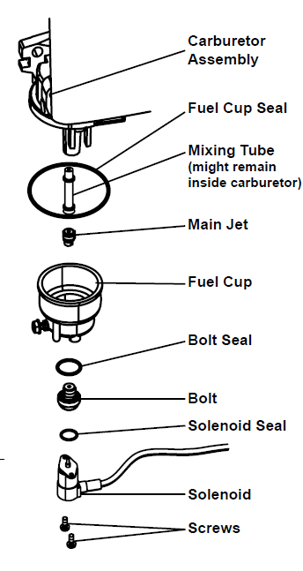
In the center of the carburetor, near the bottom of the carburetor bowl is the main jet. 
The main jet supplies fuel to the engine when it is at full throttle. 
When the main jet becomes blocked, the engine will stall at full throttle. Once stalled, the governor will close the throttle. At this point the carburetor’s idle circuit will begin to supply fuel and the engine will fire once again and the throttle will return to full. 
This cycle repeats over and over, causing the engine to die and surge. Fixing a surging engine is usually a matter of cleaning the carburetor..."


Atomizer 
Mixing tube- long cylindrical tube with holes
Tall end which goes into the venture and short end next has a Phillips head to the Main Jet
Float 
Needle and hinge pin
Carburetor bowl
Bolt seal, Bolt 
Auto Choke Mechanism
Gaskets
Air box
Air filter 
Carb Cleaner -vinegar and water - neutralize rust


Does Your Lawn Mower Sound Like It Is Surging?  
Grime and dirt can gum up the internal components of your carburetor, making it fail to receive the correct flow of fuel. 
Solution: You can take your mower to a small engine repair shop to have the carburetor removed and cleaned. 
1.Disassemble the carburetor. For you to reach the carburetor, you’re likely to have to disconnect the air filter, fuel tank, governor control link, breather pipe, and manifold seal and keeper ring. 
2. Clean the carburetor with a carburetor cleaner that’s appropriate for your mower engine, paying special attention to the needle valves, orifices, and ports. You’ll need to replace the carburetor if its body is in poor condition or damaged. 
3. Once you’ve given the carburetor a good cleaning, reassemble the mower components in reverse order..."

Run on Choke only
Choke is decreasing air and increase vacuum which sucks more fuel in to cylinder.
Cause - Starvation of fuel

Fuel Strainer/Filter Blocks
When choke - Close outer butterfly valve restricts the airflow coming into the carburetor, builds a vacuum in Venture and draws down harder on the jet, pulling more fuel out 

Fuel Cap - Vent hole (Breeder valve) create a vacuum Blocked
As air moves down the fuel tank it creates a vacuum, when vacuum builds up it draws air from vent hole to balance the pressure and the fuel will flow. 

Air Leak in Fuel Line to Carburetor
It gives you more air to fuel and does not create a good fuel/air combustion.
Inlet manifold gasket leaking/Bolt loosen
Carb adjustment screws


Module 4  - Governor System


Governor main purpose is a feedback controlling mechanism. 
It balances the speed of the engine rpm's to adapt to various load conditions. 
Steady engine Speed: Governor Flyweights and Governor spring force are balance ; 
Loss of engine Speed: Governor spring force exceeds Flyweight Force (Throttle opens to regain speed) Engine overspeed: Governor Flyweight Force exceeds spring force (Throttle closes to decrease the speed)

The governor gear is driven by the crankshaft
The Governor flyweights are attached to the governor gear
These flyweights are hinged and contain a lever that contacts the governor regulating pin 
The governor regulating pin transfer motion from the flyweight to the Governor's cross shaft 

Purpose:  
The governor balances the speed of the engine rpm's to adapt to various load conditions. 

Principle of Operation
The governor gear is driven by the crankshaft
the Governor flyweights are attached to the governor gear
These flyweights are hinged and contain a lever that contacts the governor regulating pin 
The governor regulating pin transfer motion from the flyweight to the Governor's cross shaft 

Increase the speed of the Governor's gear increase the centrifugal force on the governor's flyweights
As the flights moves outwards, they force the regulating pin away from the governor's gear
The regulating pin is in contact with the cross shaft and causes it to rotate
The cross shaft is connected to the governor lever

Summary of Operation

Steady engine Speed: 
Governor Flyweights and Governor spring force are balance 

Loss of engine Speed: 
Governor spring force exceeds Flyweight Force (Throttle opens)

Engine overspeed: 
Governor Flyweight Force exceeds spring force (Throttle closes)

Gear mechanism spins the mechanical Governor gear assembly.
It rotates and centrifugal forces causes 2 mechanical counterweights in the Governor assembly to move outwards.
Including the springs and weights
he spring and the mechanism, wether its weights or fan type, work together to hold the set revs.
https://www.youtube.com/watch?v=3jUpb71D3is


Module 5  - Ignition System and Electric

2 types of timing 
Electrical - Ignition
Mechanical – Flywheel Key  - Fuel at the right time, Valves at the right time, spark at the right time, piston at the right time – all maintain with the Flywheel key. 


Flywheel operates weathervane (springs brings it back when it slows down) it controls the governor/carburetor throttle 
It controls constant speed of the engine 
Works in conjunction with governor spring and idle spring
Flywheel made of aluminum on lawn mower made of cast iron
Aluminum flywheel isn’t heavy enough to maintain momentum of piston going up and down in cylinder, so the flywheel and lawnmower blade is part of flywheel to maintain momentum. 
Flywheel fins are not the same in height – it change the harmonics.
Inside flywheel are magnets and as the flywheel spins, it passes in front of a stationary coil, builds up a magnetic field and as it passes the coil it collapse the field and induce a charge to the spark plug where we get our ignition.

Ignition (Spark) Related
Spark plug cap not connected securely
Spark plug electrode wet or dirty
Incorrect spark plug gap
Spark plug cap broken
Circuit breaker trip (electric start models only)
Incorrect spark timing or faulty ignition system


Troubleshooting

Engine will not start

For combustion to occur you'll need fuel, spark, air and compression.

Fuel Related
No fuel in tank
Cold Engine, Choke is not in Choke position
Gasoline with more that 10% ethanol used
Low quality or deteriorated, old Gas
Carburetor is not prime
Dirty fuel passageways
Carburetor needle stuck, Fuel can be smell in the air
Too much fuel in chamber. This can be cause by carburetor needle sticking
Clogged fuel filter 

Ignition (Spark) Related
Spark plug cap not connected securely
Spark plug electrode wet or dirty
Incorrect spark plug gap
Spark plug cap broken
Circuit breaker trip (electric start models only)
Incorrect spark timing or faulty ignition system

Compression Related
Cylinder not lubricated. Problem after long storage periods
Loose or broken spark plug (hissing noise will occur when trying to start)
Loose cylinder head or damage head gasket (hissing noise will occur when trying to start)
Engine valves or tappets mis-adjusted or stuck

Monday, October 17, 2022

BASMATI Biriyani Recipe

 Ingredients list:


STEP 1 700 GR BASMATI RICE - WASH AND SOAK IN WATER FOR AT LEAST 1 HOUR BEFORE COOKING STEP 2 CHICKEN MARINADE - MARINADE FOR AT LEAST 1 HOUR BEFORE COOKING 1 KG CHICKEN 1 TSP SALT 1 TSP TURMERIC POWDER 1.5 TSP CHILLI POWDER 2 TSP CURRY POWDER 2 TSP CORIANDER POWDER 0.5 CUMIN POWDER 0.5 TSP GARAM MASALA POWDER 4 TBS VEGETABLE OIL 4 TBS YOGURT STEP 3 RICE: 700 GR BASMATI RICE 1 TBS OIL 3 BAY LEAF (TEZ PATA) 2 STAR ANISE 1 TSP CUMIN SEEDS 2 CINNAMON (CASIA BARK) 5 CLOVE 6 CARDAMIN 1 TSP GINGER PASTE 1 TSP SALT STEP 4 CHICKEN BHUNA: 3 TBS GHEE 380 GR ONION (3 MED ONION) 1 TBS GINGER PASTE 1.5 TBS GARLIC PASTE 2 TSP SALT 10 GREEN CHILLI 6 ALOO BAKHARA (DRIED PLUM) STEP 5 LAYER THE BIRIYANI: 1ST LAYER 1 TBS GHEE 2ND LAYER RICE 3RD LAYER CHCIKEN BHUNA 4TH LAYER RICE TOP REMAINING BHUNA SAUCE & CORIANDER FOIL THE TOP TO KEEP STEAM LOCKED IN TO STEAM COOK THE RICE. COOK THE RICE 30 MINS ON LOW HEAT. LEAVE 30 MINS TO REST BEFORE MIXING AND ENJOYING THE AMAZING BIRIYANI...